The Science of Life on Earth and Beyond
What defines life beyond its chemical makeup? This question is more than philosophical—it shapes how scientists search for life beyond Earth. While life on our planet is familiar, discovering it elsewhere may require redefining what “life” actually means.
A recent study by Stuart Bartlett of Caltech and his co-authors, published in PRX Life, presents a fresh framework for defining life that extends beyond Earth-centric assumptions. Instead of viewing life purely as chemical or thermodynamic systems, Bartlett introduces an informational perspective.
Life as Semantic Information
The study differentiates between two types of information:
1. Syntactic Information
Raw data without inherent meaning, which organisms can ignore without affecting their survival.
2. Semantic Information (SI)
Information that directly influences an organism’s ability to survive. For example, recognizing that a red berry is poisonous helps an organism avoid harm.
Central to this framework is viability. Life is defined by a simple yet fundamental goal: staying alive. Complex systems such as hurricanes or rocks, despite their chemical and thermodynamic activity, do not pursue survival—they have no intrinsic drive to maintain viability.
Life constantly monitors its surroundings: available food, temperature changes, toxins, and other factors that affect survival. This information forms the core of Semantic Information. Non-living systems, by contrast, have no need to process such data.
The Lyfe Framework
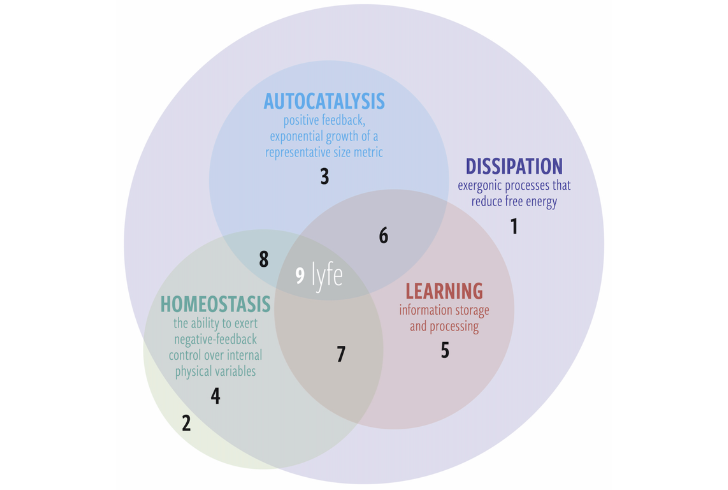
mdpi.com | Bartlett’s Lyfe Framework uses Dissipation, Autocatalysis, Homeostasis, and Learning to define life.
Bartlett’s approach, known as the Lyfe Framework, outlines four pillars essential to understanding universal life:
1. Dissipation – Using energy to maintain internal processes.
2. Autocatalysis – The ability to grow and reproduce.
3. Homeostasis – Maintaining stability despite environmental changes.
4. Learning – Processing information to improve survival chances.
The concept of Semantic Information adds depth to the learning pillar, highlighting how life processes information to enhance viability.
Implications for the Origins of Life
This framework reframes the origin of life not as the emergence of a specific molecule like DNA, but as the Information Transition—when molecules began processing environmental information to improve survival. Unlike many abiogenesis theories, Bartlett’s model offers a falsifiable approach.
Experiments involve structures called chemical gardens, which self-assemble when metal salts mix in a solution. Using an Epsilon Machine, a pattern-generating algorithm, scientists can encode hidden patterns into electrical signals. These signals interact with the chemical garden, potentially inducing mineral reactions that reflect the encoded information.
By comparing the internal structure of the garden to the algorithm, researchers can test whether these minerals are capable of processing information—a key step in validating the framework.
Life Beyond Earth

Freepik | Scientists can use the practical Lyfe Framework to explore life’s emergence without speculation.
The framework also informs the search for extraterrestrial life. For cells to monitor their surroundings and enhance survival, they require sensors. Physics sets a lower limit on cell size at 0.4 micrometers. Smaller cells would be disrupted by Brownian motion, causing inaccurate environmental readings that could threaten survival. This minimum size is likely universal, whether on Earth, Titan, or other planets.
Detecting alien life may involve sending signals to another planet and observing responses. A “smart” reaction, such as an increase in information output, could indicate life. Additionally, Assembly Theory can measure molecular complexity, identifying molecules too intricate to form randomly, suggesting an informationally driven process like evolution.
Practical Applications and Considerations
The Lyfe Framework provides both a conceptual and practical tool for understanding life. By offering falsifiable tests, scientists can explore life’s emergence without relying on speculative methods. Debates continue about actively sending signals to other worlds, but observing responses could reveal new insights into alien biology.
Understanding life as matter intertwined with meaningful information offers a fresh lens for studying both Earthly and extraterrestrial life. By focusing on viability, information processing, and minimal structural requirements, the Lyfe Framework redefines what it means to be alive. This approach not only deepens scientific understanding of life’s origins but also guides the search for life across the cosmos, expanding the boundaries of our knowledge.